
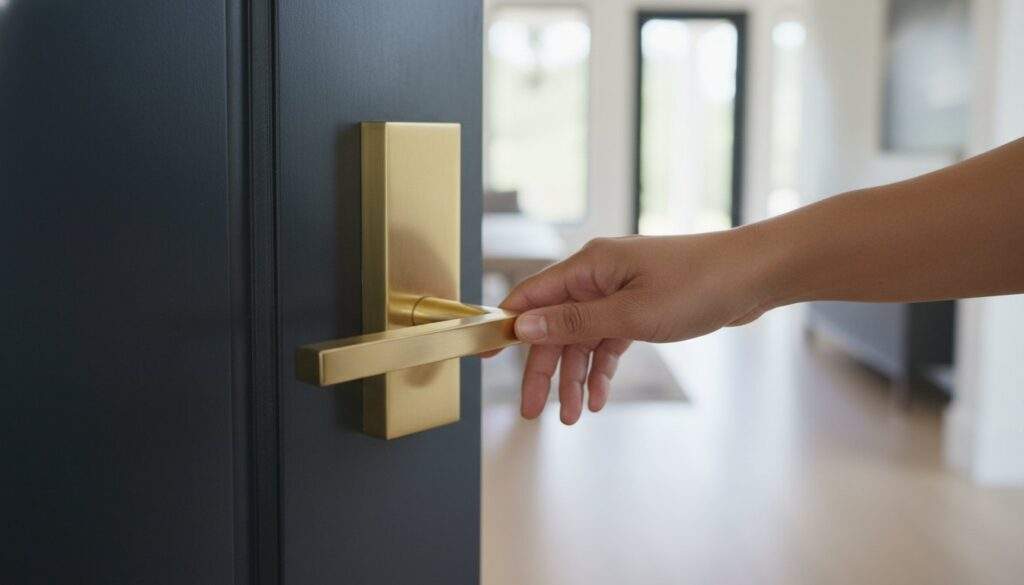
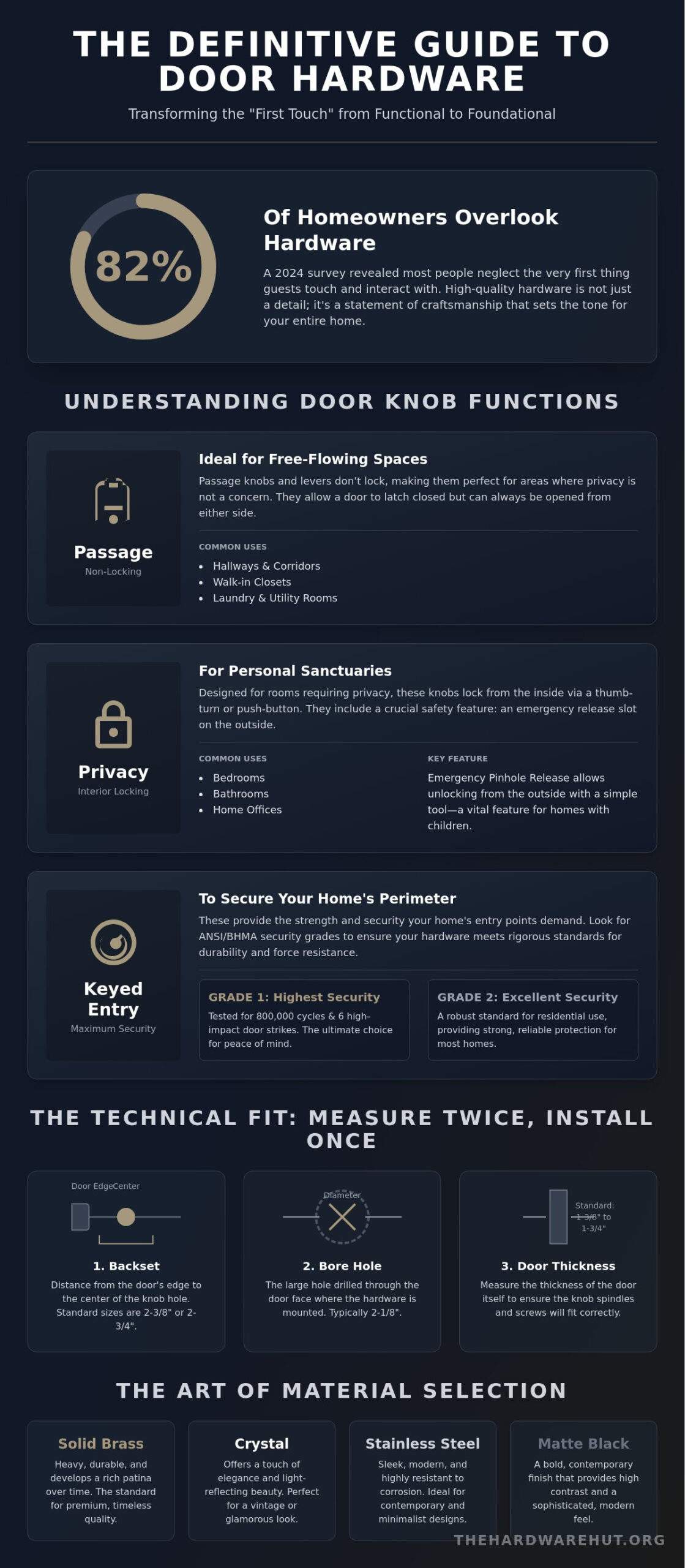
Great design begins at the door, yet a 2024 interior design survey revealed that 82% of homeowners overlook the very first thing their guests actually touch. You likely spent months selecting the perfect reclaimed oak flooring or the precise shade of “gallery white” for your walls, only to find yourself staring at a hardware aisle feeling completely overwhelmed. It’s a common frustration to fear that a small technical measurement error will lead to a “cheap” look or that mixing brass and matte black will disrupt your home’s harmony. Choosing the right door knobs shouldn’t feel like a gamble on your home’s aesthetic integrity.
We believe your hardware is more than just metal; it’s a silent detail that defines your home’s personality. Whether you’re restoring a heritage property, building a modern sanctuary, or simply upgrading a single room, you deserve hardware that offers style, strength, and a premium weight. This definitive 2026 guide promises to transform your “first touch” from a functional necessity into a curated statement of craftsmanship. We’ll cover the three technical measurements you must get right, the professional secret to mixing finishes, and how to select materials that feel heavy and substantial in your hand.
Key Takeaways
- Discover why high-quality hardware is an investment in craftsmanship and how the “first touch” sets the narrative for your home’s unique story.
- Learn to distinguish between passage and privacy door knobs to ensure your home functions with the effortless grace and security your family deserves.
- Explore the sensory differences between premium materials like solid brass and crystal to find the perfect balance of tactile beauty and long-term resilience.
- Master the essential measurements and technical jargon required to ensure your new hardware provides a seamless, frustration-free fit during your next upgrade.
The Philosophy of the First Touch: Why Door Knobs Matter
Great design begins at the door. It’s a fundamental truth we’ve championed since our family first began this journey in Spokane back in 1945. For nearly 80 years, we’ve understood that door knobs represent the primary tactile interaction between a guest and a home. They serve as a physical handshake, a “First Touch” that introduces the story of your living space. While some see a tool, we see an investment in craftsmanship. These pieces are more than just metal; they are the curated elements that turn a house into a sanctuary of style, strength, and simplicity.
The history of door handles reveals a steady evolution from basic utility to high-end design. At The Hardware Hut, we treat every piece as a “Silent Detail.” This concept describes how hardware subtly elevates room transitions, guiding the eye and the hand through a home with intentionality. Whether you’re building a new legacy, remodeling a kitchen, or restoring a cherished family estate, the hardware you choose sets the stage for everything that follows.
The Psychology of Quality Hardware
The weight of a handle tells a story before a single word is spoken. When a guest reaches for a door, the sensory impact of the material and the mechanical smoothness of the turn provide an immediate signal of quality. Premium-grade hardware suggests a home built with integrity and care. We believe architectural hardware is the marriage of form and function. It’s the difference between a door that simply opens and one that welcomes you in with a reassuring, solid click. This tactile feedback creates a lasting impression of permanence and luxury.
Setting the Tone for Your Interior
Door hardware acts as the jewelry of a room. Much like a carefully chosen watch or a signature necklace, door knobs define a home’s personality from the very first impression. They bridge the gap between architectural structure and personal expression. Whether your style is sleek and modern or timeless and traditional, these details anchor your design vision. They provide the finishing touch that makes a space feel complete. For more design inspiration and deep dives into current trends, visit our blog category to find the perfect match for your home’s story.
Understanding Function: Passage, Privacy, and Beyond
Great design begins at the door. It’s the silent detail that shapes how you move through your home every single day. Choosing the right door knobs is about more than just metal; it’s an investment in your home’s personality. Whether you’re building a new legacy, remodeling a classic, or simply upgrading your first touch points, selecting the correct function ensures your home remains a sanctuary of style, purpose, and peace.
Interior Functions: Passage and Privacy
The distinction between interior functions is the most common source of confusion for homeowners. To create a seamless flow, you must match the hardware’s capability to the room’s intended use. Most interior spaces fall into two categories:
- Passage: These sets have no locking mechanism. They’re the workhorses for hallways, laundry rooms, and walk-in closets where you want the door to stay closed but never locked.
- Privacy: This is the standard for bedrooms and bathrooms. These knobs include an interior locking mechanism, usually a thumb-turn or a push-button, to offer a quiet retreat from the rest of the house.
Modern privacy hardware includes an emergency release on the exterior side. This small pinhole allows the lock to be disengaged from the outside using a simple tool. It’s a vital safety feature for families with young children who might accidentally lock themselves in. When planning your layout, you should also consider ADA accessibility guidelines. These standards recommend hardware that’s easy to operate without tight grasping or twisting, ensuring your home is welcoming to every guest.
Exterior and Specialty Functions
Keyed entry functions provide the strength and security your home’s perimeter demands. These are essential for front doors, back entries, and garage access points. To protect your investment, look for ANSI/BHMA security grades. A Grade 2 lock is excellent for standard residential use, while a Grade 1 lock represents the highest level of security. Grade 1 locks are tested to withstand 800,000 cycles and 6 separate high-impact door strikes, providing ultimate peace of mind. For those seeking a rugged, old-world aesthetic for gates or side entries, iron hardware offers a timeless, hand-forged look that stands up to the elements.
Dummy knobs serve a purely decorative purpose. They don’t have a latch or a turning mechanism. These are the perfect solution for shallow pantry closets, ball-catch doors, or the inactive side of a pair of French doors. They maintain a consistent visual story throughout your home without the need for functional internal parts. If you’re unsure which function fits your specific door prep, the experts at The Hardware Hut can guide you through our curated collections to find the perfect match for your home’s story.
Materials and Finishes: The Art of Lasting Craftsmanship
Great design begins at the door. At The Hardware Hut, we view hardware as more than just metal; it’s the handshake of your home. The tactile sensation of turning door knobs is often the first interaction a guest has with your space. This silent detail sets the tone for the entire interior narrative, making the choice of material and finish an essential investment in your home’s personality.
Choosing the Right Material
The material you select determines the longevity and “soul” of the hardware. We prioritize premium-grade options that stand the test of time and touch.
- Solid Brass: This remains the gold standard for luxury and detail. Its high copper content allows for intricate designs and a heavy, satisfying weight. Unlike plated zinc, solid brass won’t rust or corrode, ensuring your investment lasts for generations.
- Stainless Steel: This is the ideal choice for modern aesthetics. It’s particularly effective in high-moisture areas or coastal environments where salt air is a factor. Grade 304 or 316 stainless steel offers a crisp, industrial strength that feels cool and clinical to the touch.
- Crystal and Porcelain: These materials add a touch of timeless, vintage elegance. Crystal catches the light beautifully, while porcelain offers a smooth, ceramic warmth. Both are perfect for restoration projects or adding a curated, heirloom quality to a new build.
Finishes that Tell a Story
A finish is the final layer of your home’s story. While some prefer a look that stays pristine, others find beauty in evolution. Living finishes, such as unlacquered brass, are designed to change. They react to the oils in your hands and the oxygen in the air, developing a unique patina that reflects how you live in your space. If you prefer a finish that never fades, PVD (Physical Vapor Deposition) coatings use a high-tech vacuum process to create a surface that’s virtually unscratchable.
Choosing between Satin Nickel and Chrome often depends on the “temperature” of your room. Satin Nickel provides a soft, brushed warmth that hides fingerprints well. Chrome offers a high-shine, mirror-like reflection that feels energetic and clean. For those seeking a professional perspective on these technical choices, this expert guide on choosing door hardware provides excellent structural advice.
A cohesive home requires harmony between different rooms. You should coordinate your door hardware with your cabinet hardware to create a unified flow. The same principle extends to every moving part of your cabinetry; our comprehensive guide to premium cabinet hinges shows how selecting the right hinge finish and style completes the curated look you’re building throughout your home. Looking ahead to 2026, the trend of strict matching is fading. Designers are now embracing a curated look by mixing finishes. Pairing matte black door knobs with satin brass hinges creates a sophisticated, multi-dimensional aesthetic that feels collected over time rather than bought from a box. For those ready to take their entry to the next level, exploring electronic keyless locks offers a way to blend sophisticated design with modern security without sacrificing your home’s curated aesthetic.
The Technical Fit: Measuring for a Seamless Upgrade
Great design begins at the door, but even the most exquisite door knobs lose their allure if they don’t operate with silent precision. At The Hardware Hut, we believe hardware is an investment in craftsmanship, acting as the tactile “first touch” that defines your home’s personality. We’ve spent decades helping families ensure this silent detail is perfect. You don’t need to be a master carpenter to achieve a professional fit; you simply need a few minutes and a standard tape measure to demystify the technical side of your upgrade.
The Three Essential Measurements
Precision is the foundation of hospitality. Follow this foolproof checklist to ensure your new hardware integrates perfectly with your existing door prep.
- Step 1: Measuring the Backset. This is the distance from the edge of the door to the center of the bore hole. For a quick visual scale, a standard credit card is 3.375 inches long. A 2-3/8 inch backset covers roughly 70% of that card’s length. The only other common standard is 2-3/4 inches.
- Step 2: Checking Door Thickness. Most modern interior doors are 1-3/8 inches thick, while exterior doors are typically 1-3/4 inches. If your door is custom and exceeds these by even 1/8 of an inch, you’ll likely need a specialized spindle.
- Step 3: Verifying the Bore Hole. The industry standard diameter for door knobs is 2-1/8 inches. Verifying this ensures your new rose or backplate will fully conceal the opening, maintaining a sleek, curated look.
Handling Non-Standard Doors
Historic homes and custom architectural builds often feature narrow stiles or “thick door” requirements that standard hardware won’t accommodate. If your door measures 2 inches or more, you’ll need to specify a thick door kit during your selection process. For homes built before 1945, you might encounter mortise locks, which are complex metal boxes recessed into the door’s edge. These systems offer timeless security but often require a professional to ensure the new trim aligns with the old internal mechanics. Correct measurement is the bridge between a beautiful design and a functional door. Our family-run team is honored to help you find solutions that respect your home’s story while providing modern reliability. If you’re upgrading an exterior entry and want to combine precise fit with cutting-edge convenience, our guide to electronic keyless locks that elevate your home’s security and first touch walks you through how smart entry hardware integrates with standard door preparations.
Does your project require a specific aesthetic or material? View our curated iron hardware collection to find pieces that offer both strength and timeless style.
Curating Your Home’s Story with The Hardware Hut
Great design begins at the door. It is the first physical interaction a guest has with your space and the last detail they touch as they leave. Since 1945, our family has viewed hardware as much more than just metal. It is a legacy. As a family-run business for nearly 80 years, we have transitioned from a local Spokane dream into a global resource for those who value craftsmanship. We don’t just act as a retailer; we serve as a trusted mentor for your home’s unique narrative. Our philosophy is simple: we only curate and sell products that we would proudly use in our own homes.
More Than Just a Store
Our team brings eight decades of architectural hardware expertise to every project. This deep-rooted knowledge is why trade professionals and discerning homeowners trust our selection over big-box alternatives. We understand that a home’s personality lives in the silent detail. Whether you are searching for high-end door knobs or bespoke cabinet pulls, our curated approach ensures every piece meets a standard of style, strength, and simplicity. We take pride in our Spokane-based roots, where our experts personally vet each manufacturer for quality and durability. That same standard of precision applies to every component we carry, including the premium cabinet hinges that keep your cabinetry operating with the same quiet confidence as your finest door hardware.
- Heritage Expertise: Benefit from 80 years of industry-leading design knowledge.
- Trusted Curation: Every item is hand-selected for its premium-grade materials and finish.
- Global Reach: We provide fast, secure shipping to ensure your “first touch” arrives safely, no matter where you live.
- Personal Service: Experience the warmth of a family-run business that treats your home like our own.
Start Your Design Journey
It’s time to view your hardware as a long-term investment in craftsmanship rather than a mere utility. The right door knobs can elevate a room from ordinary to aspirational, providing a tactile sense of quality every time you turn a handle. We’re honored to help you navigate these choices, ensuring your home reflects your personal taste and high standards. Don’t settle for mass-produced hardware that lacks soul. Instead, choose pieces that tell a story of hospitality and care. You can begin browsing The Hardware Hut homepage today to explore our full catalog and find the silent details that will define your home for years to come.
Crafting a Legacy Through the First Touch
Great design begins at the door. It’s the silent detail that defines your home’s personality. By mastering technical measurements and selecting finishes that age with grace, you’re doing more than just picking hardware. You’re investing in craftsmanship that stands the test of time. Whether you’re selecting passage sets for the hall or privacy locks for the suite, your choices represent the first impression guests receive when they enter your space.
Since 1945, our Spokane-based family business has curated a selection of premium-grade architectural hardware for both residential and commercial projects. We’ve spent 81 years helping homeowners turn functional needs into lasting stories. Our experts are here to support your 2026 vision with quality we’d proudly use in our own homes. Elevate your home’s first touch; shop our curated door knobs today. Your home deserves a touch of excellence that lasts for generations.
Frequently Asked Questions
What is the difference between a door knob and a door lever?
A door knob features a traditional spherical design that requires a twisting motion, while a door lever uses a horizontal handle that you push down to operate. Great design begins at the door, and choosing between them depends on your home’s unique story. Levers are often the preferred choice for universal design, as the 1990 Americans with Disabilities Act standards indicate they are easier for those with limited hand strength to use. Whether you seek the timeless curve of a knob or the sleek utility of a lever, both elevate your daily experience.
What is a standard backset for residential door knobs?
The standard backset for most residential door knobs is either 2-3/8 inches or 2-3/4 inches. You measure this distance from the edge of the door to the center of the pre-drilled bore hole. Since 1950, these two dimensions have accounted for 99% of North American residential door preparations. Always verify your specific measurement before purchasing to ensure your new hardware fits with precision and grace. This small detail ensures a seamless installation that respects the craftsmanship of your home.
Can I replace my door knobs myself without a professional?
You can certainly replace your hardware yourself using only a Phillips head screwdriver and about 15 minutes of your time. This simple upgrade is one of the most effective ways to refresh your home’s personality without the need for a professional contractor. Our family-run business has guided homeowners through this process for over 30 years, proving that premium results don’t always require complex tools. It’s an empowering way to care for your quality of life through small, silent details that you touch every day.
Is it okay to mix different finishes for door knobs in the same house?
Mixing finishes is a sophisticated way to add depth and character to your home’s personal story. Designers often follow the 60-30-10 rule, where 60% of the hardware remains a dominant finish like satin nickel while 30% and 10% feature curated accent tones. This intentional approach prevents your home from feeling like a sterile showroom. It creates a sense of heritage and warmth that feels deeply personal and welcoming to every guest who visits.
What does “passage function” mean for a door knob?
A passage function means the hardware does not have a locking mechanism and turns freely from both sides of the door. This is the ideal choice for hallways, closets, or laundry rooms where privacy isn’t a requirement. In a typical 2,500 square foot home, about 70% of the interior doors usually utilize this specific function. It focuses on the tactile experience of the first touch without the unnecessary complexity of a key or a thumbturn.
How do I know if a door knob is high quality before buying?
High-quality door knobs are distinguished by their physical weight, material composition, and official BHMA durability ratings. Premium-grade hardware is typically forged from solid brass or stainless steel rather than thin, stamped metals that feel hollow. Look for a Grade 2 rating, which signifies the hardware has successfully passed 400,000 cycles of testing for strength. Investing in craftsmanship ensures your hardware remains a timeless, functional part of your home for decades to come.
What is a dummy door knob and where should I use it?
A dummy door knob is a non-functional, stationary handle that doesn’t turn or have any internal latch mechanism. You should use these on pairs of French doors or shallow pantry closets where a simple pull is all you need to open the door. They act as a silent detail that maintains visual symmetry across your interior design. Since they require no bore hole, you can install them in under 5 minutes using simple surface-mounted screws.
How do I measure my door thickness for new hardware?
To measure your door thickness, hold a tape measure against the edge of the door and record the distance from the interior face to the exterior face. Standard interior doors measure 1-3/8 inches thick, while exterior doors are typically 1-3/4 inches thick. These two sizes account for approximately 95% of residential entries built in the United States since 1970. Knowing this exact number ensures your hardware fits securely, providing that premium, solid feel every time you enter a room.